GtkHx is a client for Hotline, the chat and file-sharing system from 1996. A Hotline server is a small community of its own: a public chat room, private messages, a shared file library, and a news board, all run by whoever hosts it. Trackers list the servers that are up, so you can go looking for one.
GtkHx was first written in 2000 for GTK+ 1.2. It has since been rebuilt for GTK 4 and libadwaita, and much of it rewritten in Rust, while staying fully compatible with the Hotline 1.2, 1.5 and 1.9 servers still running today.
Get GtkHx
The current version is 1.6.2.
- Linux: the Flatpak, from GtkHx’s own repository. Install it with
flatpak install --user https://dl.gtkhx.org/gtkhx.flatpakref, and it updates like any other Flatpak app.gtkhx-beta.flatpakreffollows the betas instead. - macOS: the
.zipfor Apple silicon (arm64) or Intel (x86_64), from the latest release. - Windows: the
win64.zip, from the latest release.
Or build it yourself. What’s new in each version is in the changelog.
Screenshots
 Threaded news
 Browsing a server’s files
 Video chat and screen sharing
 Transfers you can pause and resume, and the server’s queue
 Finding servers on a tracker
 The Classic theme, with the original pixel-art icons
Finding a server
GtkHx comes with a few servers in Settings → Connections to get you started. For more, open the tracker (Ctrl+T): it lists the servers that are online now, and you can search them by name.
Features
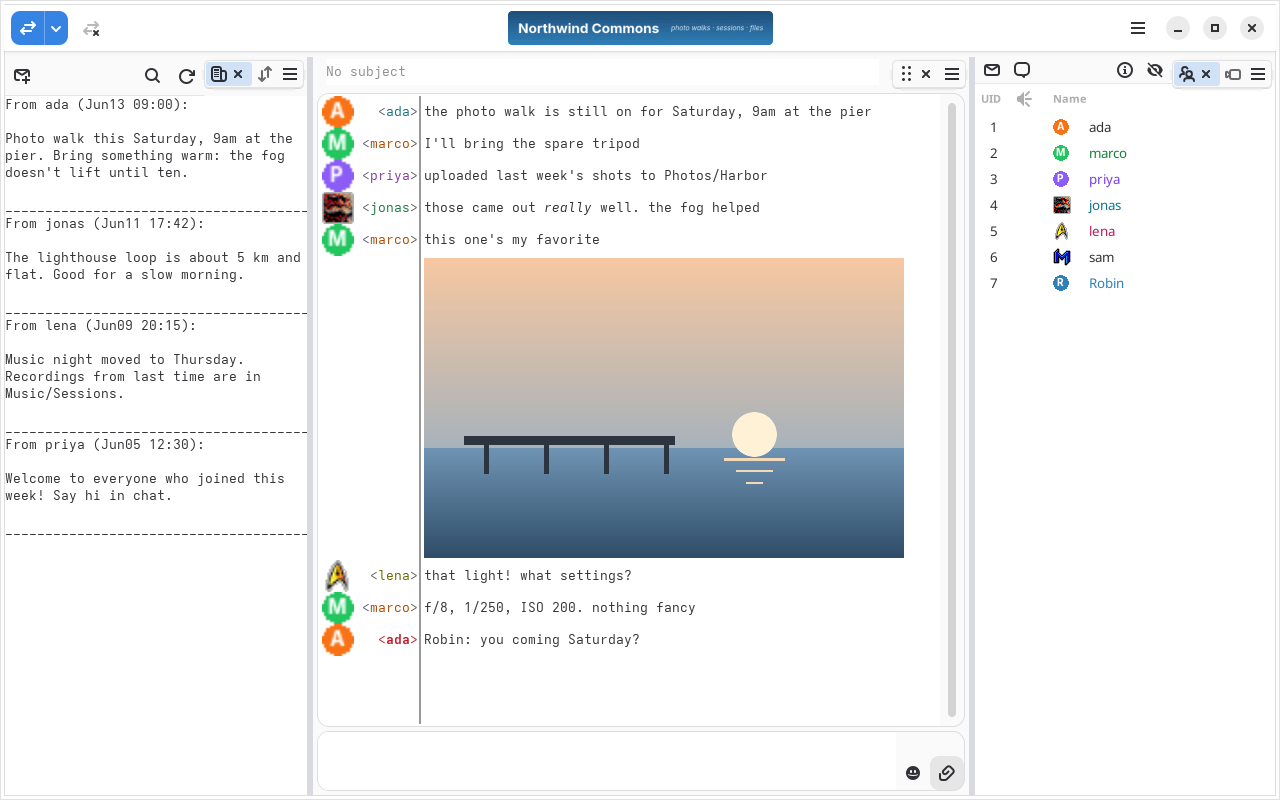
- Chat with formatted text, colored names, inline images, emoji shortcodes, and a searchable history
- Private messages, which can carry pictures, and private chat rooms
- Files: a two-panel browser for downloading and uploading, with downloads and uploads, files and folders alike, that you can pause and resume, and previews of images, PDFs, source code and classic Mac PICT files, and of audio and video, which play as they download
- News: both the original flat news and threaded news with categories, replies and pictures
- Voice chat, video chat and screen sharing, on servers that support them
- Several servers at once, each in its own tab
- Secure connections over TLS, with fingerprint pinning, and encrypted logins with Blowfish or ChaCha20-Poly1305; a lock in the header bar shows when a connection is encrypted, and how
- Your layout: dock panels side by side, drag their tabs between panes, or pull them out into windows of their own, the way the original Hotline client worked
- Themes, light and dark, including a Classic theme with the original pixel-art icons
- Notifications and a tray icon
- Update notices in the Flatpak, which can update and restart itself
- Accessible: screen readers can name every control and are told of private messages and mentions, nearly everything works from the keyboard (Ctrl+? lists every key), and themes follow the system’s high-contrast setting
- Runs on Linux, macOS and Windows
GtkHx also speaks the modern extensions some servers offer: native UTF-8, large file transfers, chat history, GIF icons, and tracker v3 with search.
GtkHx works with any Hotline 1.2, 1.5 or 1.9 server. It is tested against mhxd, Janus, hxd-ng, hlservd (the Hotline 1.9 server) and the Argus tracker.
History
GtkHx began in 2000 as a GTK+ front end to hx, the terminal client Ryan Nielsen and David Raufeisen wrote alongside hxd, the open-source Hotline server. Over the next three years it grew into a client of its own, with threaded news, resumable file transfers and HOPE secure logins. Version 0.9.4, in May 2003, was the last release for more than twenty years.
In 2026, Misha Nasledov picked it back up. The Hotline servers were still running, and the people on them were still talking, but there was nothing modern on Linux to connect with. GtkHx was carried forward through GTK 2 and 3 to GTK 4 and libadwaita, released as 1.0, and has been rewritten in Rust piece by piece ever since. Along the way it picked up what the community added to Hotline in the meantime, from TLS and chat history to voice and video, without ever breaking the old servers it was written for.
Thanks
GtkHx had help the first time around, and its About window still says so:
- Ryan Nielsen and David Raufeisen, whose hx client it grew out of
- Aaron Lehmann, who helped fix a few things
- Jean-Sebastien Hubert, who contributed translations
- Philip Neustrom, who wrote a guide to using the original version
- Jonathan C. Sitte, who made the original GtkHx website on SourceForge
- apocalypse, a collaborator on the original
Community
The Hotline Wiki keeps the history of Hotline and the clients, servers and trackers still around today, and it’s the best place to start looking for somewhere to connect. Its Discord is where much of the community talks now, Misha included, and a good place to ask about GtkHx.
License
GtkHx is free software, under the GNU General Public License, version 2 or (at your option) any later version. The source is on GitHub.